SEE THE LIGHT
There’s an ethereal, mystical quality to artist Clarice Bdeckett’s work that casts a spell over art lovers, including these South Australians who have loaned their treasured paintings for a major exhibition at the Art Gallery of SA.
“It’s about that light,” says Roscoe Shelton, explaining why he loves Clarice Beckett’s paintings.
“That half-light at the very end of the day or the very beginning of the morning, and the mistiness that comes through … the best sunrises and sunsets, they’re fleeting.”
Roscoe first saw the Australian painter’s works at a 1971 exhibition in Melbourne presented by researcher and former gallery owner Dr Rosalind Hollinrake, who is credited with rediscovering Clarice after she vanished from art history for several decades following her death in 1935. Rosalind presented two exhibitions in the early ‘70s after a chance meeting with Clarice’s sister Hilda led her to salvage hundreds of neglected canvases from a remote shed in rural Victoria.
Back then, Roscoe was a 21-year-old engineering student and had begun collecting a few paintings. Like Clarice, his father had been a student of artist and teacher Max Meldrum and Roscoe knew Max’s daughters Ida and Elsa, so he sought their advice on Clarice’s work before reaching into his pocket.
“The Clarice Beckett paintings were paintings that I could afford,” he says, recalling that he paid just $140 for the first one.
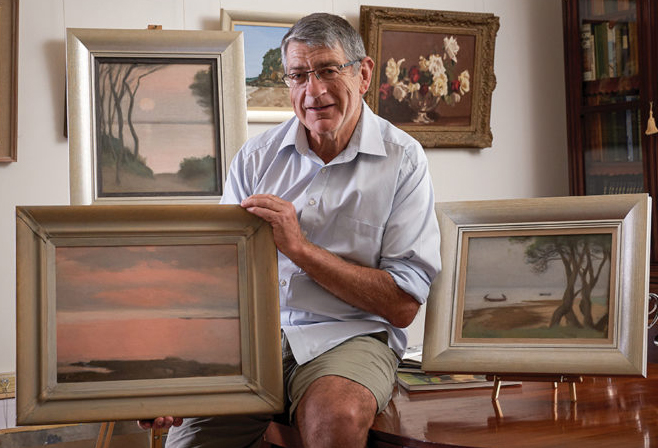
Today, Roscoe, now retired, owns three Beckett paintings, all of which were bought in the 1970s and are on loan to the Art Gallery of South Australia for its exhibition Clarice Beckett: The Present Moment.
One of the paintings – Early morning, fishing -hasn’t been publicly exhibited in 50 years. The two others, Sunset and Sunset in the Bay, capture the fading light at Victoria’s Port Phillip Bay. Exhibition curator Tracey Lock describes Clarice as a series of sunsets as “among the most sublime statements in Australian landscape art”.
Although he’s made some astute acquisitions, Roscoe says his art purchases are driven by love for an artwork rather than investment potential. He and his wife Jillian’s Adelaide home is full of paintings – including a Max Meldrum and works bt his father and other Meldrum students – and as he speaks about art, he points out the commonalities and contrasts between different artists and their techniques.
In recent years, Roscoe has also started painting himself, and when trying to perfectly capture a scene – especially the shifting light – he finds motivation in Clarice’s work.
“Clarice Beckett has captured what I call the very essence of those evening lights and those morning lights, and no one else really does that to the skill level that she’s done. She’s taken the skill of that Meldrum school and delivered the outcome that everyone aspires to.”
Her work, he adds, is even more impressive given that she was painting en plein air in the 1920s and 1930s: “In today’s era, people take photographs and take them home and paint them; in that era, it would be really quite a rapid paint because they had to capture it at the moment. So when you look at the detail of what Clarice has done, it is remarkable.”
The Art Gallery of South Australia considers Clarice Beckett one of the country’s finest painters of the 20th century. The Present Moment is the most comprehensive retrospective of her work ever staged, with nearly 130 her paintings of everyday scenes and nature presented in a way that charts the chronology of a single day, from sunrise to nightfall.